Tagged: Dynamic Geometry

Pi Day 2015: Pieces of Pi

For this year’s Pi Day post, I thought I’d continue our Web Sketchpad (WSP) construction theme. But rather than adapting the visualizations from last year’s Pi Day post to the new construction capabilities, I decided to take a different approach. Some time ago, I built a set of custom tools for the non-Web version of...

Drawing an Ellipse with Pins and String

In my prior blog posts, I’ve described how to construct ellipses using linkages, concentric circles, congruent triangles, and tangent circles. These are all great methods, but I think I got ahead of myself: There’s a simple ellipse construction technique described in nearly every precalculus book that I’ve bypassed in my excitement to show you the more exotic approaches. Say hello to...

Innovative Approaches to Computer-Based Assessment, Part Four

For the past month, I’ve focused this blog on the role that computers can play in assessing students’ mathematical knowledge. I’ve presented three Web Sketchpad-based examples of assessment with mathematical topics ranging from isosceles triangles, to the Pythagorean Theorem, to the slopes of perpendicular lines. Throughout, I’ve tried to show that the introduction of the computer...

Exploring Factor Rainbows

This week, I’m going to describe one of my favorite activities for introducing young learners to multiplication and factors. It comes from  Nathalie Sinclair, a professor of mathematics education at Simon Fraser University. In the interactive Web Sketchpad model below (and here), press Jump Along to watch the bunny take 2 jumps of 4 along...

Refutation in a Dynamic Geometry Context

Michael de Villiers teaches courses in mathematics and mathematics education at University of KwaZulu-Natal in South Africa. His website features a wealth of Dynamic Geometry-related books, articles, and sketches. He is the author of the Sketchpad activity module Rethinking Proof with The Geometer’s Sketchpad. This blog post is a condensed version of a longer article, “Conjecturing, Refuting and Proving...

A Quartet of Ellipse Constructions

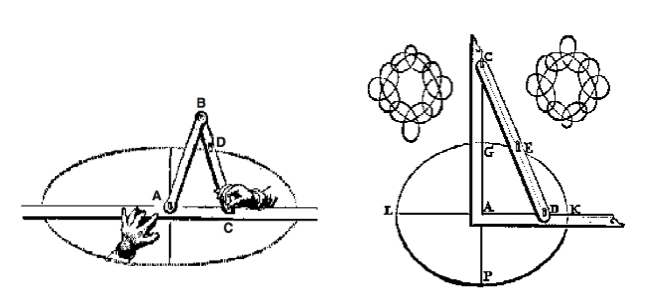
The 17th-century Dutch mathematician Frans van Schooten developed “hands-on manipulatives” centuries before the term became popular in math education circles. Below are two images of ellipse-drawing linkages from van Schooten’s manuscript, Sive de Organica Conicarum Sectionum in Plano Descriptione, Tractatus (A Treatise on Devices for Drawing Conic Sections). Building physical models of these devices isn’t hard....

Tribute to Zalman Usiskin

On November 6 I had the honor of being one of the panelists in a Symposium Honoring Zalman Usiskin, held to honor Zal’s many years of contributions to mathematics education, from his groundbreaking 1971 textbook Geometry: A Transformation Approach (GATA) to his continuing activities today. My panel was supposed to discuss his work on the...

Isosceles Triangle Puzzles

As readers of this blog can probably tell, I like puzzles. I especially enjoy taking ordinary mathematical topics that might not seem puzzle worthy and finding ways to inject some challenge, excitement, and mystery into them. This week, I set my sights on isosceles triangles. It’s common to encounter isosceles triangles as supporting players in geometric proofs,...

Pentaflake Chaos

Dan Anderson commented on my Pentaflake post to observe that the pentaflake can also be created by a random process, sometimes called the Chaos Game. In this game you start with an arbitrary point and dilate it toward a target point that’s randomly chosen from some set of points that you’ve established. You then dilate...