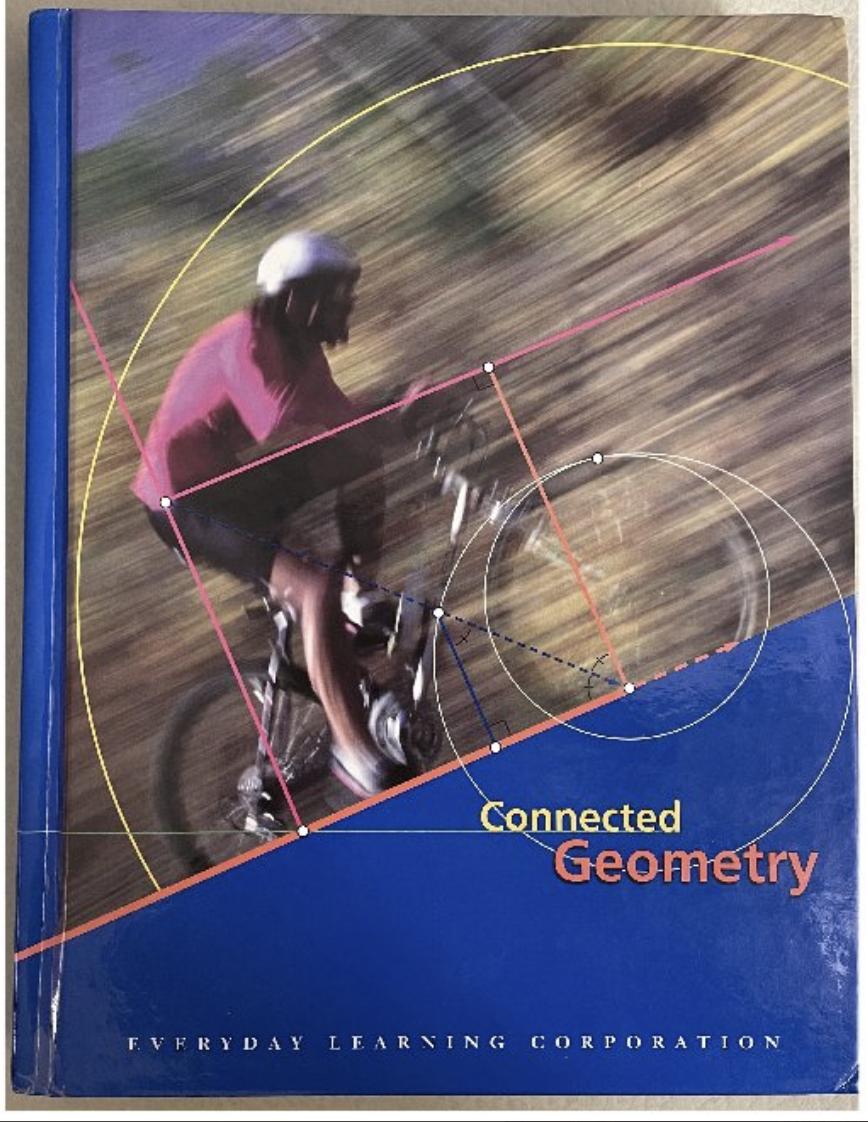
Connected Geometry
It’s that time of year when we start seeing “best of” lists for books, movies, music and the like. In that spirit, but stretching way beyond the past year, some of my favorite geometry textbooks include Geometry: Seeing, Doing, Understanding (Harold Jacobs), Discovering Geometry (Michael Serra), and Geometry: A Transformation Approach (Coxford & Usiskin).
There’s another geometry textbook that I think is worthy of being added to the list, but I’ll mention it separately since, as one of its authors, I might be a little biased. Connected Geometry was authored by a team at Education Development Center (EDC) in the mid 1990s, and was funded by a grant from the National Science Foundation. Our team had great fun writing the curriculum. Without much interference from our publisher, we were able to include topics like geometric optimization and geometric dissections that normally wouldn’t find their way into a traditional textbook. We were one of the first curricula to embrace dynamic geometry software, which, at the time, was quite new. And the now ubiquitous habits-of-mind principles also had their roots in the curriculum.
I mention all of this because Connected Geometry is now available for free on the Internet Archive. You can download each of its six chapters as a PDF file. You’ll find Web Sketchpad-supported examples from the Connected Geometry curriculum on our blog (here, here, here, and here) with more examples to come.